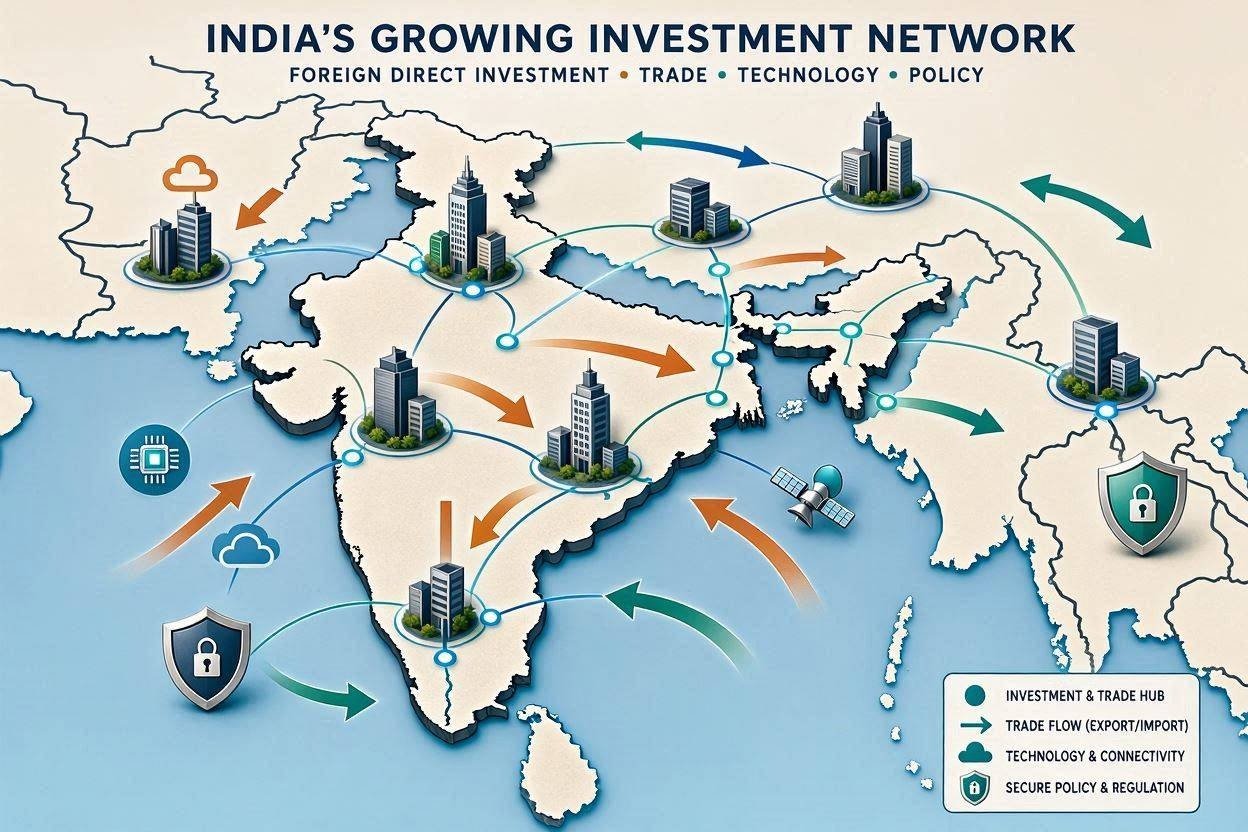
Softening the Borders: Relaxing FDI Norms for Land Border Countries
In a significant policy shift, the Government of India has relaxed aspects of its Foreign Direct Investment (FDI) framework governing investments from countries sharing a land border with India. The move marks a departure from the restrictive regime introduced through Press Note 3 (2020), which required prior government approval for investments originating from or beneficially owned by entities in neighboring countries.
The policy change reflects the government's attempt to strike a balance between safeguarding national security and facilitating economic growth through increased foreign investment. The reforms are expected to improve investor confidence, accelerate capital inflows, and strengthen India's position in global supply chains.
Background: Press Note 3 and the Security Imperative
In April 2020, amid concerns regarding opportunistic takeovers during the COVID-19 pandemic, India introduced Press Note 3 (PN3). The measure mandated government approval for investments from entities situated in countries sharing a land border with India, including China, Pakistan, Bangladesh, Nepal, Bhutan, Myanmar, and Afghanistan.
The policy was primarily aimed at preventing hostile acquisitions of Indian companies during a period of economic vulnerability. However, over time, investors and industry stakeholders raised concerns about regulatory uncertainty, prolonged approval timelines, and ambiguity surrounding the concept of "beneficial ownership."
The New Reforms
The revised framework introduces greater clarity and procedural efficiency. One of the most significant changes is the adoption of a more defined beneficial ownership threshold. Earlier, even minimal ownership links to a land-border country could trigger government approval requirements. The revised approach aligns beneficial ownership determination with existing anti-money laundering norms.
The government has also introduced a fast-track approval mechanism for specified sectors. Applications falling within eligible categories are expected to receive decisions within 60 days, reducing regulatory delays and improving ease of doing business.
Additionally, certain non-controlling investments with limited ownership exposure may no longer require the same level of scrutiny that existed under the previous framework.
Economic Rationale Behind the Shift
India's FDI inflows have faced headwinds in recent years, prompting policymakers to reassess regulatory barriers. Industry bodies have argued that the stringent approval process discouraged investments from global funds and multinational investors whose ownership structures included minority holdings from neighboring countries.
The reforms are expected to facilitate investment in critical sectors such as electronics manufacturing, renewable energy, capital goods, deep technology, and supply-chain infrastructure. By reducing procedural uncertainty, the government aims to attract long-term capital while preserving strategic safeguards.
National Security Considerations Remain
Despite the relaxation, the government has clarified that entities registered in countries sharing a land border with India, particularly China and Hong Kong-based entities, may still require government approval. The revised framework is therefore not a complete liberalization but a calibrated easing of restrictions.
Strategic sectors involving sensitive technologies, critical infrastructure, national security, and data-intensive businesses will continue to remain subject to heightened scrutiny.
Potential Impact on Investors and Industry
The policy revision is expected to benefit venture capital funds, private equity investors, manufacturing companies, and technology firms. Many global investment vehicles maintain diversified ownership structures that previously triggered approval requirements despite lacking any controlling interest from neighboring-country investors.
By reducing ambiguity and introducing defined timelines, the reforms may improve predictability for investors and encourage greater participation in India's growth story. The measures also align with broader government initiatives aimed at boosting manufacturing, enhancing technological collaboration, and integrating Indian industry with global value chains.
Conclusion
The relaxation of FDI norms for land-border countries signals a pragmatic shift in India's investment policy. While national security considerations remain central, the government has sought to reduce regulatory friction and improve investment efficiency. Whether the reforms translate into higher capital inflows and increased investor confidence will depend on their implementation and the effectiveness of accompanying safeguards.