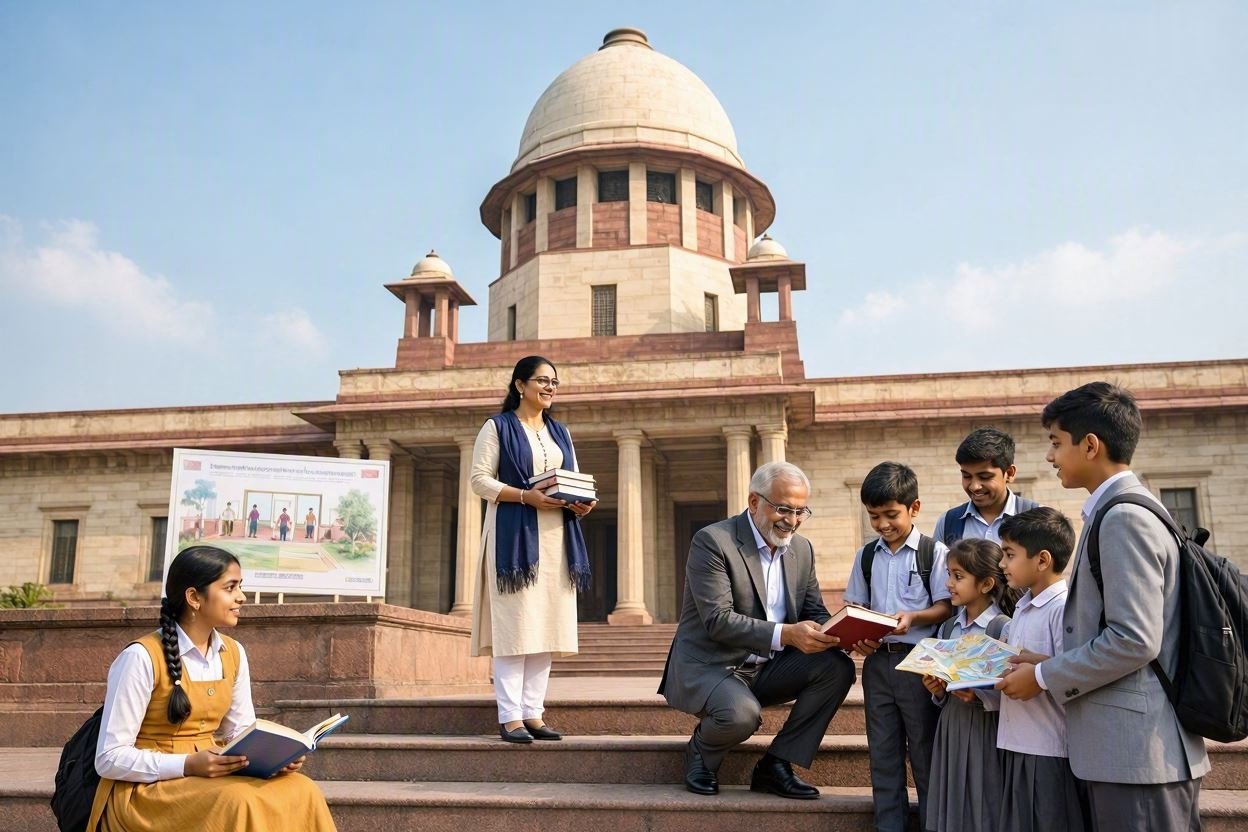
The Supreme Court of India has passed an interim order prohibiting the appointment and continuation of teachers in schools and colleges who do not meet the qualifications prescribed under the applicable statutory framework. The Court emphasized that educational standards cannot be compromised by bypassing qualification requirements mandated under law.
The order was issued during proceedings in a Public Interest Litigation (PIL) challenging certain teacher provincialisation schemes. The petition alleged that these schemes enabled the regularisation or continuation of teaching staff who lacked the qualifications required under governing statutes and regulatory norms.
Observing that teacher qualifications are governed by specific legislative and regulatory frameworks, the Court clarified that compliance with standards prescribed under the Right of Children to Free and Compulsory Education Act, 2009 (RTE Act), National Council for Teacher Education (NCTE) regulations, and University Grants Commission (UGC) norms is mandatory.
The Bench stated that statutory qualifications cannot be diluted through executive policies or provincialisation measures. Any appointment or continuation of unqualified teachers would undermine the legislative intent behind maintaining educational quality and professional standards in educational institutions.
The Court consequently restrained authorities from appointing or continuing teachers who do not satisfy the prescribed eligibility criteria until further orders. Notices have been issued to the concerned respondents, and the matter remains under consideration.
The ruling is significant for educational institutions and state governments across India, as it reinforces the supremacy of statutory qualification requirements over administrative schemes. It also signals stricter judicial scrutiny of recruitment and regularisation policies that may conflict with educational standards established by Parliament and regulatory bodies.
Legal experts believe the order could influence future recruitment policies, teacher regularisation schemes, and ongoing disputes concerning educational appointments. The matter is expected to have broader implications for governance, accountability, and quality assurance in the education sector.